
The New Smart
Jensen Huang And What Smart Looks Like Now
Article
The Future Of Jaguar
Business
Y/Magazine
Article
Business
The Jaguar Type 01 was unveiled in New York yesterday. It is extraordinary, controversial, technically remarkable, and being sold into one of the most difficult markets a luxury car has faced in a generation. Whether it succeeds will determine not just the future of Jaguar but the answer to a question the entire automotive industry is watching: can a century-old brand erase itself and become something else entirely, and should it?
T
The car that Jaguar unveiled at a venue called STORIED in New York on October 6, 2026 took six years to bring to market, consumed a company's entire production output in the process, generated more cultural controversy per unit sold than almost any automotive rebrand in living memory, and costs $130,500. It is called the Type 01. It produces 1,030 horsepower from three electric motors, reaches 62 miles per hour in 3.2 seconds, offers an estimated 450-mile range from its 118 kilowatt-hour battery, can add 200 miles of charge in thirteen minutes via a 350-kilowatt connection, and required more than 7,000 wind tunnel sessions and 360 patent applications to engineer. It weighs over two and a half tonnes and sits no higher than 1.4 metres off the ground. The most aerodynamic Jaguar ever built. The most powerful road car the brand has ever produced. The first production vehicle created on the Jaguar Electric Architecture platform that will underpin every model the company makes from this point forward.
It is also a four-door sedan, in a market that has spent the better part of a decade migrating comprehensively toward SUVs. It is a luxury EV, in a segment facing what analysts are calling a significant softening of demand. It is entering a competitive field that includes the Porsche Taycan, the Bentley electric, and a Ferrari EV that received a notably hostile reception earlier this year for departing too far from the brand's DNA. And it is doing all of this while carrying the residual weight of one of the most polarising brand relaunch campaigns in the history of the automotive industry, launched in November 2024 with a promotional video that contained no cars and generated responses ranging from genuine admiration to Nigel Farage predicting the company's imminent demise.
Two years on from that moment, the Type 01 is Jaguar's answer to every question the rebrand raised and declined to resolve. It is, at last, the car.
In November 2024, Jaguar announced a new brand identity under the tagline "Copy Nothing" and released a campaign video featuring a diverse cast of models in vivid, androgynous clothing moving through an abstract landscape with no automobiles visible anywhere in the footage. The reaction was instantaneous and, by most measures, disproportionate. The video received millions of views in its first forty-eight hours, the overwhelming majority of which were driven by outrage, bafflement, or the specific quality of mockery that the internet reserves for institutions that appear to have lost contact with their own purpose. The comments were, by turns, political, homophobic, nostalgic, and genuinely funny. Elon Musk asked, on X, "Do you sell cars?" The question became a meme. The meme became a cultural moment of the specific kind that nobody in a marketing department intends and nobody can fully control once it arrives.
What the coverage mostly missed, in its enthusiasm for the spectacle of a 102-year-old British institution apparently trying to become a luxury fashion house, was the structural reality that made the gamble comprehensible if not inevitable. Jaguar's sales had been in serious decline for years. The brand had tried multiple times to find a new positioning within the premium automotive market and had succeeded only in blurring what it was, selling cars that competed uneasily against BMW, Audi, and Mercedes without the engineering heritage to win on technical grounds or the brand prestige to win on cultural ones.
Its customer base was ageing, literally: the average Jaguar buyer was old, getting older, and not being replaced by younger consumers who found the brand either desirable or relevant. The company had, in the language of its own executives, a brand awareness problem where awareness was mostly associated with the past and a customer acquisition problem where the new customers it needed to survive were not arriving. The company had, in the language of its own executives, a brand awareness problem where awareness was mostly associated with the past and a customer acquisition problem where the new customers it needed to survive were not arriving.
The solution Jaguar and its parent company JLR chose was the most radical available: stop making the cars, pause production entirely while the new platform and the new models were developed, declare that only fifteen percent of existing customers were expected to follow the brand into its new era, and bet everything on the proposition that a sufficiently dramatic repositioning could attract a new, younger, wealthier audience who had never previously considered owning a Jaguar. The Type 00 concept, unveiled at Miami Art Week in December 2024 in colours called Miami Pink and London Blue, was the first physical evidence of what this repositioning would look like: a low, elongated GT shape with Art Deco proportions, a long bonnet that made no concession to the packaging logic of electric vehicles, and an interior spine architecture that created four individual occupant spaces rather than a conventional cabin. Extraordinary and strange and immediately divisive. Either a genuine vision or an expensive provocation. Possibly both.
The Type 01, unveiled in New York yesterday, is what the Type 00 concept was always pointed toward.
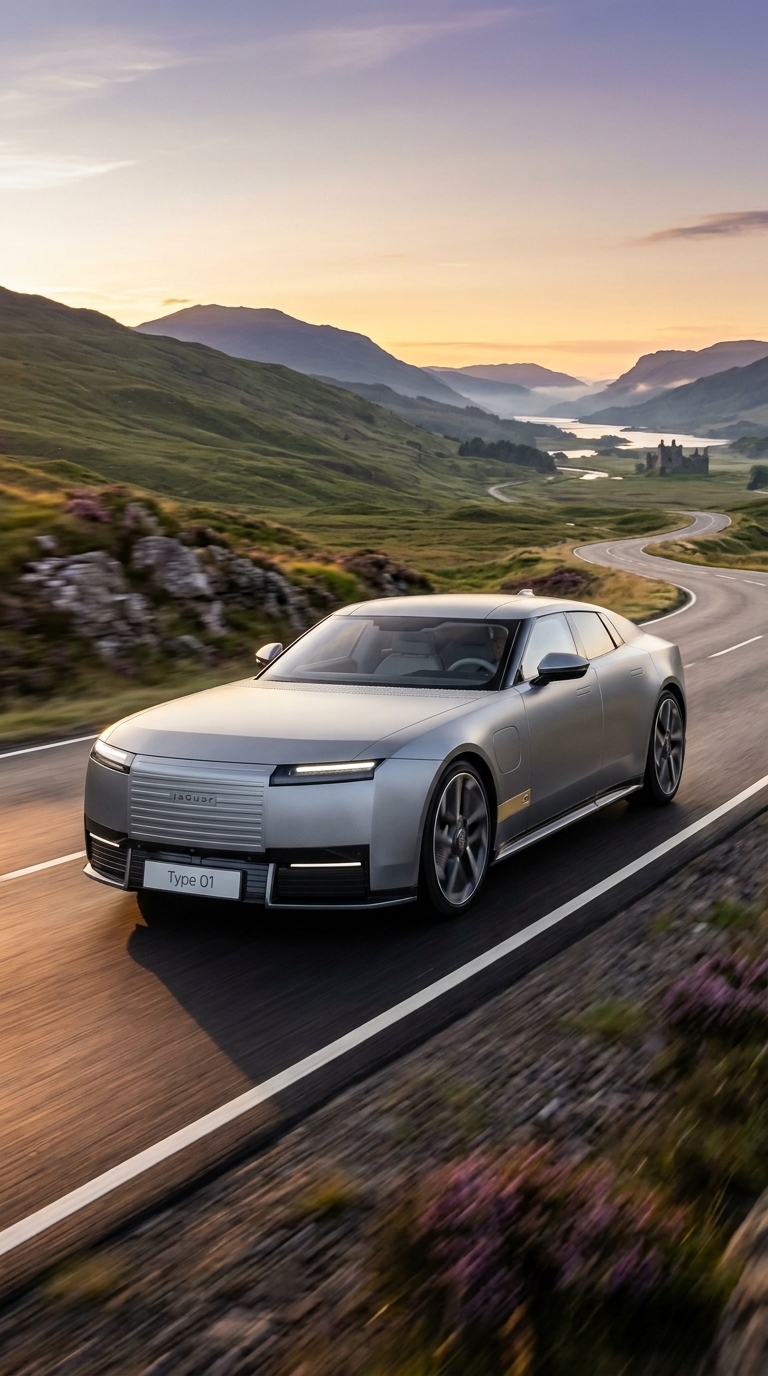
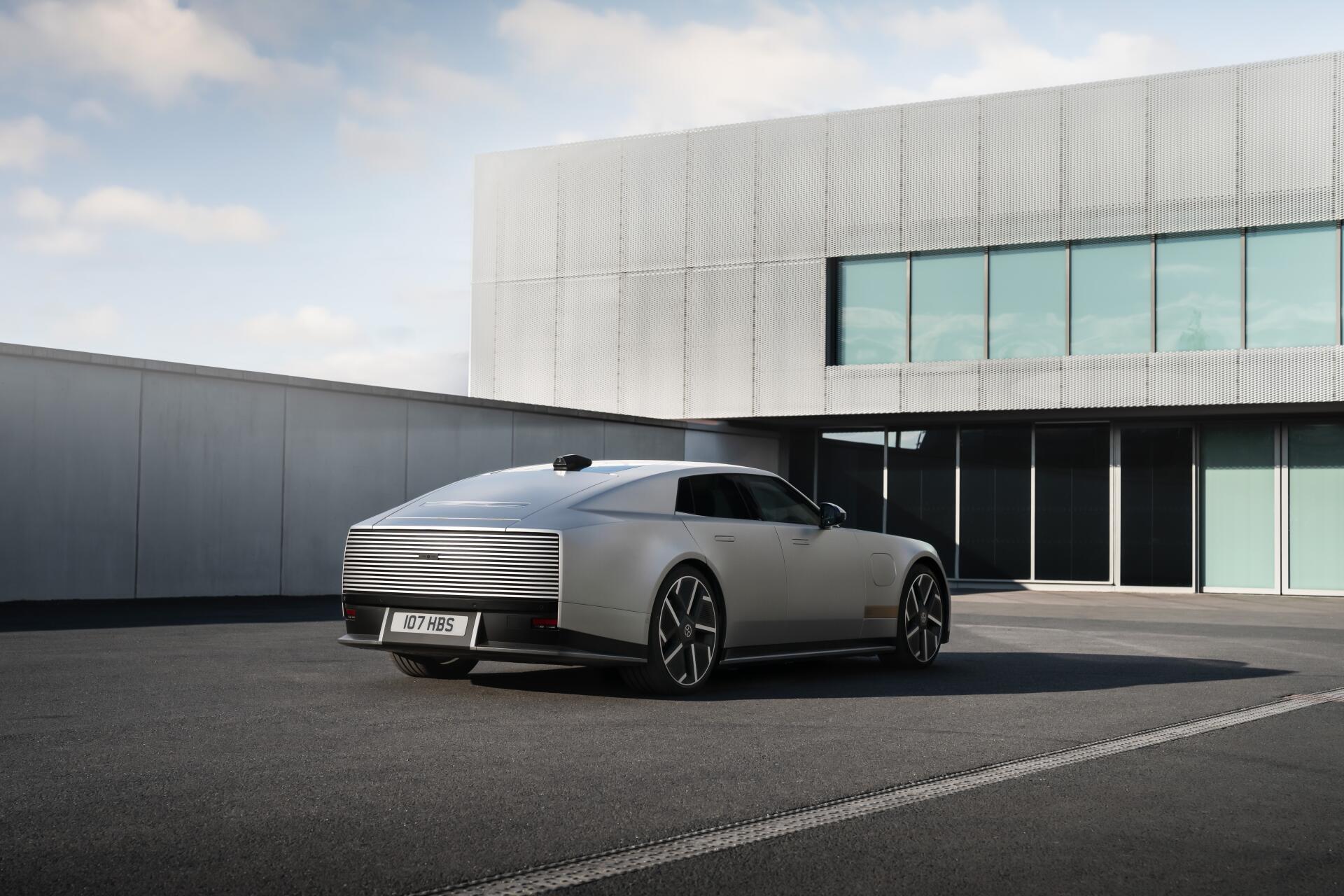
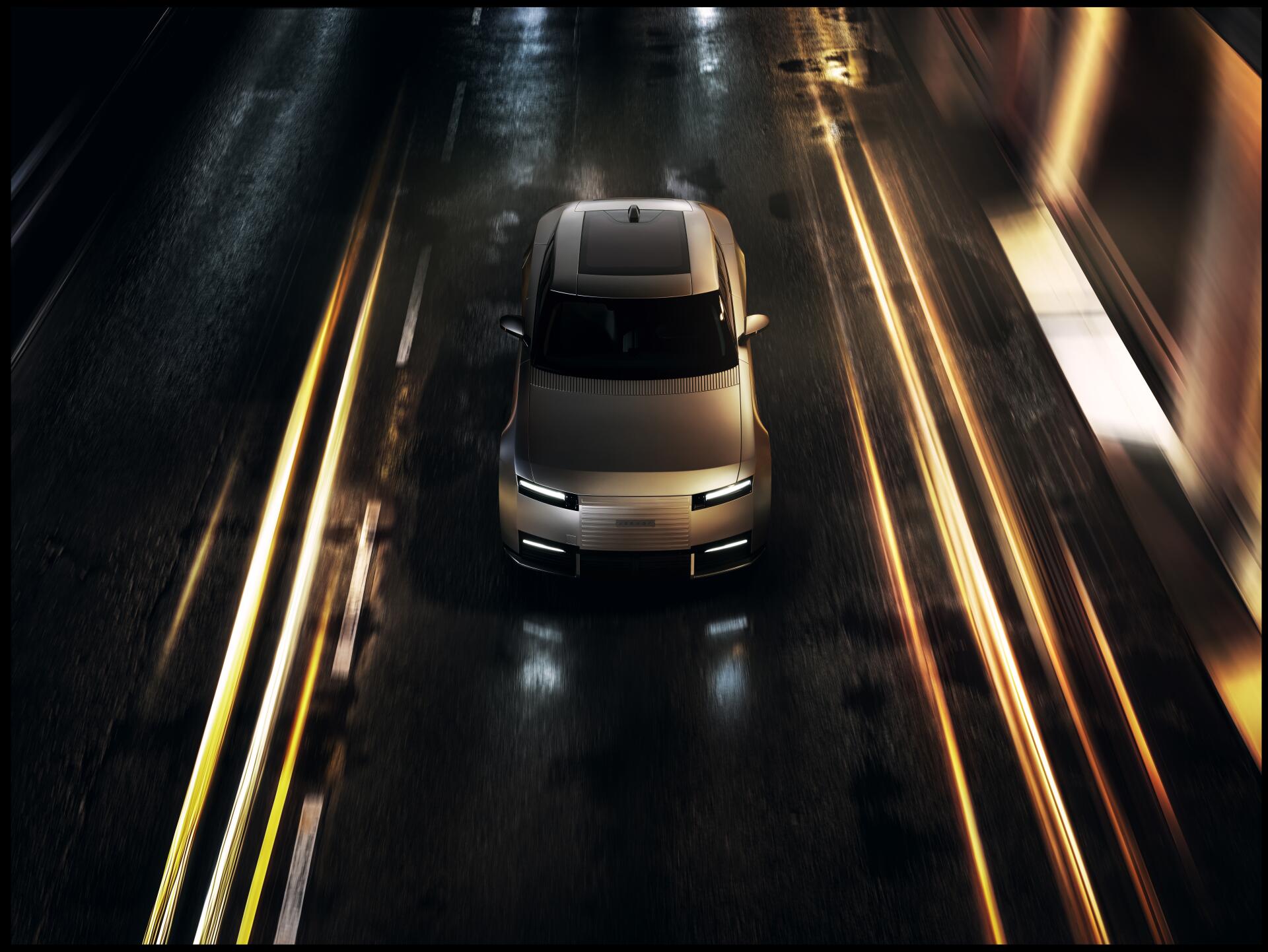
The first thing that matters about the Type 01 is that it is beautiful, which is both the most important thing and the thing that is most difficult to say with confidence before you have encountered it in person. Beauty in automotive design is a contested judgment, and the early online reaction to the Type 01 demonstrates this with characteristic efficiency: reactions ranged from "the best looking EV I've seen" and "magnificent" to "an armored car with a fastback roof" and "hideous." Both readings are available. The car is not a design that occupies the uncontested middle ground of admiration. It is a design that stakes a position and holds it, which is what the company said it would produce and what the Type 00 concept suggested it was capable of.
The proportions are deliberately extravagant. The bonnet is long in the way that the E-Type's bonnet was long, not as a reference to the E-Type specifically but as an expression of the same underlying conviction: that a Jaguar should look like it is moving even when it is standing still, that the front-to-rear ratio of the design should communicate energy before the engine is started. The roofline sweeps from a relatively high point above the A-pillar to a dramatically low tail, creating a side profile that Top Gear's reviewer described as "gobsmacking" at the Miami concept reveal and that the production version has largely maintained. The rear of the car is said by reviewers who have seen the finished vehicle to be as dramatic as the front, resolving the concerns raised by the concept's less satisfying tail treatment.
The technical specification is, by any measure, serious. Three motors, two at the rear on individual mountings that allow active torque vectoring, one at the front. An 850-volt electrical architecture, the same specification that powers the Porsche Taycan and that enables the fast-charging performance the company is claiming. More than 360 patent applications filed in the development process, which is the kind of number that suggests genuine engineering innovation rather than component assembly. Seventy-three percent aluminium construction, which explains both the weight challenge and the structural rigidity that the ride and handling engineers were working with.
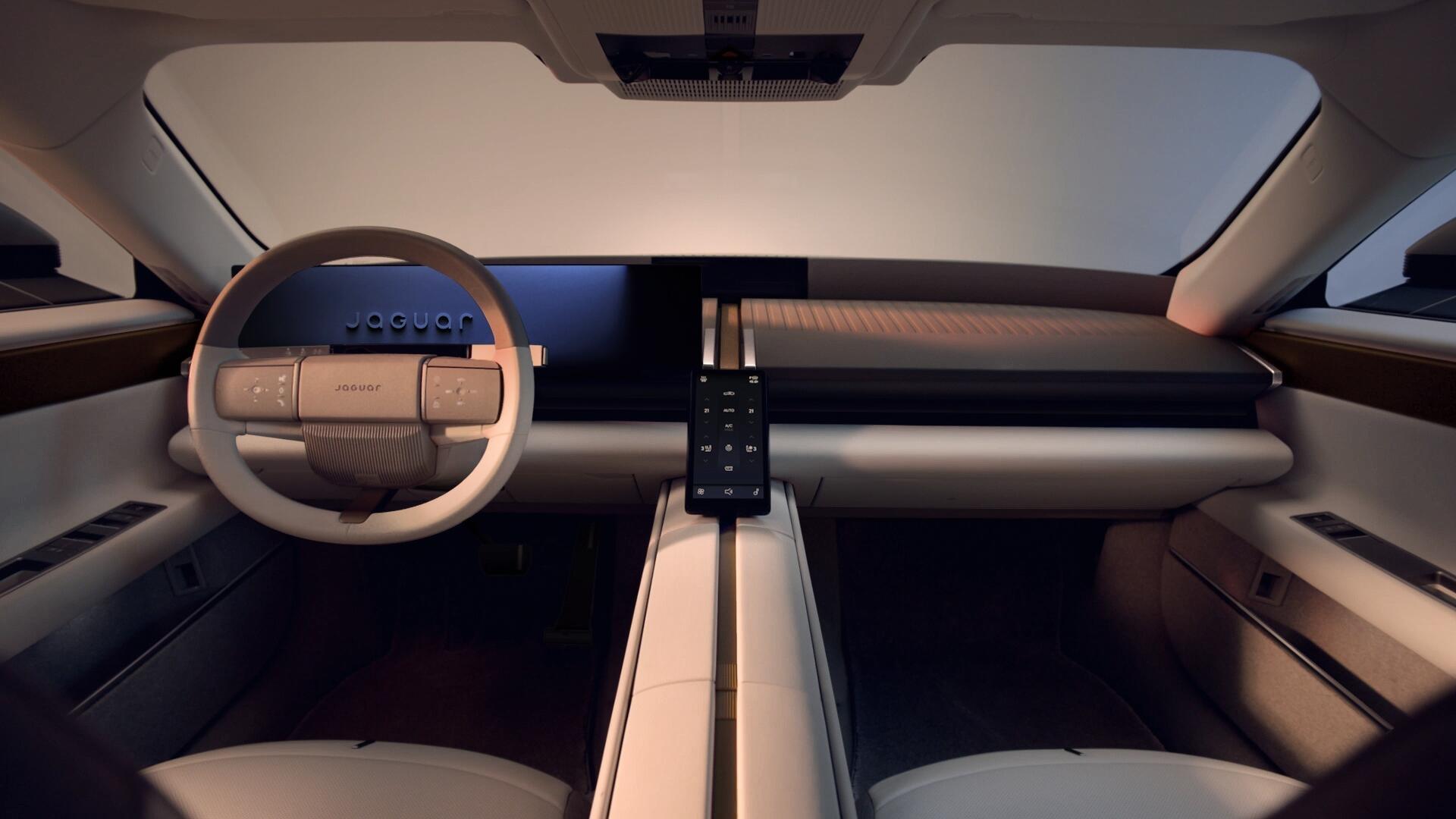
The interior is where the critical reception has been most mixed, and the reservation is specific enough to be worth addressing directly. The "brass floating spine" that bisects the cabin from front to rear is either an architecturally compelling structural gesture or a divisive affectation depending on the reviewer, and the leather-free cabin in muted, Scandinavian-adjacent palettes has been described as both refined and cold. Top Gear's reviewer noted, with precision, that the only machine rivalling the Type 01 as 2026's most controversial new car is the Ferrari Luce, which received a hostile reception for its anonymous exterior but a warmer one for its interior. The Jaguar's situation is approximately the inverse: a dramatically distinctive exterior and an interior that some find excessively restrained. The observation that it offers no visual nostalgia, no hat-tip to the XK120 or the E-Type or the XJS, is accurate and is also, from the brand's perspective, entirely intentional.
The rebrand's most quoted internal admission is the fifteen percent figure: the expectation, acknowledged by Jaguar's chief executive Rawdon Glover in a Times interview following the 2024 campaign launch, that only fifteen percent of existing customers would follow the brand through its reinvention. This is either a remarkable act of commercial candour or a remarkably high-risk business strategy, and it is worth sitting with its implications.
A luxury car brand that retains fifteen percent of its customer base during a transition from one market position to another is, by definition, betting that the new audience it intends to attract will be substantially larger than the audience it is conceding. The existing Jaguar customer was, broadly, a wealthy, conservative, brand-loyal buyer for whom the heritage of the marque, the association with British craftsmanship and a specific tradition of automotive culture, was a meaningful component of the purchase decision. The customer Jaguar is now targeting, the person it needs to acquire at sufficient volume to make the £130,000 starting price commercially viable, is younger, wealthier in absolute terms, more internationally mobile, more design-literate, and more likely to compare the Type 01 to a Porsche Taycan or a Bentley electric than to a previous Jaguar. This customer has no prior relationship with Jaguar. They are being asked to form one on the basis of a single product that has not yet been delivered to a single buyer.
The case for this working is not implausible. The luxury EV segment at the genuine top end, the territory above $100,000 where the Type 01 is positioned, is currently under-populated. Porsche owns it by default through the Taycan, Bentley is entering it, Ferrari is attempting it with the Luce and struggling. A car that combines genuine performance credentials with a visual identity sufficiently distinctive to generate cultural conversation is, in theory, exactly what the segment lacks. The Type 01's powertrain numbers are competitive. Its range is competitive. Its charging speed is competitive. If the design resonates with the audience it is designed for, rather than the audience that has spent the past two years being hostile to the concept of a Jaguar that looks like this, there is a version of the story in which this works.
The case against is equally clear. The EV sedan is the format that has performed worst in the current market cycle, as the migration to SUVs has been consistent, sustained, and seemingly structural rather than cyclical. The luxury EV market is, as Rory Carroll of Alloy noted in his post-reveal commentary, soft. First deliveries are not expected until the second half of 2027, which is a long window of commercial exposure between announcement and revenue. JLR has disclosed financial strain related to the transition, and the company has no other Jaguar products currently on sale to sustain revenue while the new platform establishes itself. The $130,500 starting price roughly doubles what the average Jaguar previously sold for, requiring a customer profile that the brand does not yet have an established relationship with. And the Florence Pugh ambassadorship, announced at the New York reveal, is unlikely by itself to move the needle among buyers spending six figures on a car.
The Type 01 is the most visible and highest-stakes example of a question that the automotive industry, and by extension the broader luxury goods industry, is having to answer with urgency: what do you do when your existing customer base is insufficient to sustain the business, and the customers you need to attract do not yet know they want you?
The conventional answer is incremental evolution: preserve the core of what the brand is while extending its relevance at the margin, adding new models, new price points, new technology, gradually shifting the demographic without alienating the base. This is what most brands do because it is the lowest-risk approach, and it is the approach that produced the Jaguar of the early 2010s to mid-2020s, a brand that had evolved enough to lose clarity about what it was without evolving enough to attract the customers it needed.
Jaguar chose the other answer: complete discontinuity, the scorched-earth approach to brand reinvention, the logic of which is that a brand that occupies a confused or declining position cannot evolve its way to a strong one and must instead destroy the existing position entirely before building a new one. This logic has historical precedent. Burberry executed a version of it under Christopher Bailey and later under Riccardo Tisci and Daniel Lee, moving from a brand associated with football hooliganism and counterfeit goods to a genuine fashion house. Apple executed the most successful version of it in corporate history, moving from a failing computer company to the most valuable brand in the world by refusing to acknowledge what Apple had previously been as a constraint on what Apple could become.
The Jaguar version of this gambit is distinguishable from those precedents in one significant respect: the product category. Clothing and consumer electronics can be repositioned relatively quickly because the product cycle is rapid and the entry price for a new customer is low. Luxury automobiles have a product cycle measured in years and a price point that requires a very specific level of committed conviction from the buyer. The Apple customer who bought a first-generation iMac was risking a few hundred dollars on a company's new direction. The Jaguar customer being asked to commit to the Type 01 is risking $130,500 on a brand that has not yet delivered a single unit of the product they are buying, in a category that is experiencing a demand softening, in a format that the broader market has been moving away from.
The naming logic of the Type 01 is worth understanding because it encodes the company's position on its own history with unusual directness. The previous generation of Jaguars used letters: C-Type, D-Type, E-Type, F-Type. The letter system implied a sequence, an evolution, a continuous line from one product to the next. The Type 00, the concept unveiled at Miami, implied a reset: not Type G or Type H but zero-zero, before the beginning, the origin point from which the new sequence would start. The Type 01 is the first unit of that new sequence. Not a successor to anything that came before. The beginning.
This is either an elegant piece of symbolic logic or an act of considerable audacity depending on your view of what a brand owes its history. The E-Type is one of the most celebrated automotive designs in history. Enzo Ferrari reportedly called it the most beautiful car ever made. Its proportions, its cultural meaning, the specific quality of longing it produces in people who never owned one and have no particular interest in owning one, constitute a form of inherited value that most brands spend decades trying to accumulate and Jaguar is choosing, deliberately and in writing, to treat as irrelevant to what it is doing now.
The Type 01 takes the E-Type's long bonnet and low roofline, translates them into the language of 2026, strips out the nostalgia and the chrome and the patinated quality of something beloved, and asks the person looking at it to respond to what it is rather than what it recalls. This is consistent with the "Copy Nothing" tagline. It is also, depending on how you receive it, either a liberation or a loss.
Top Gear's reviewer put it precisely: the Type 01 offers no visual or mechanical nostalgia, no XK120 or E-Type hat-tips. Whether this is a strength or a weakness is not a question the car answers. It is a question the market will answer, probably within the next eighteen months, when the first deliveries arrive and the conversation shifts from what the Type 01 looks like to what it is like to own.
The reveal event was held at Times Square, DUMBO, and the Lower East Side, a sequence of locations that tells its own story about who Jaguar is addressing. Not a private members' club or a gallery or a hotel ballroom. The streets of New York, specifically the streets of the New York where creative professionals, technology workers, and the culturally mobile wealthy live and move. Antonio Félix da Costa drove the car to the venue from the Jaguar TCS Racing team's Formula E operation. Florence Pugh, announced as the inaugural brand ambassador for the new era, was present. The colour palette of the production car is described in the company's materials as muted and subtle: a deliberate distance from the Miami Pink that generated the strongest reactions at the 2024 concept reveal, a recalibration toward the quieter, more assured register that the brand needs its most expensive car to occupy.
The reaction to the New York reveal is, by the standards of the 2024 rebrand campaign, almost calm. The ratio of positive to neutral to negative responses is significantly more favourable than it was for either the rebrand video or the Type 00. People who dismissed the concept as a provocation are finding the production car harder to dismiss. People who follow automotive design are discussing it with the specific quality of attention that genuinely interesting objects command. The word that appears most frequently in measured reviews is ambitious, which is not quite praise but is considerably better than hideous, and is the word that precedes admiration when admiration is not yet fully formed.
Jaguar has been making cars since 1922. It has never before erased itself and started again. The Type 01 is the first evidence of whether the erasure was worth it.
The car exists. The deliveries begin in 2027. The question that has been open since November 2024, whether a brand can copy nothing and become something, is about to receive its first real answer.

Your cart is empty